
4 min read
Salt Air, Sand, and Marsh Mud: Cleaning a Coastal New England Home
A house a mile from the water is a different cleaning problem than a house ten miles inland. Salt film, fine sand, and marsh mud each behave differently, and each has a different fix.
A house a mile from the water is a different cleaning problem than the same house ten miles inland. Not a harder one, a different one. Three things drive it here, and each behaves differently enough to need its own answer.
Salt film
Salt air carries fine aerosolized salt inland on the wind, and it lands on glass. It is not dirt, so it does not wipe like dirt. It draws moisture out of the air, which is why a window you cleaned last week looks hazy again in a way that inland glass does not, and why it always looks worse in humidity.
What to do. Clean glass more often and expect less from each cleaning. Sills and tracks matter more than the pane, because that is where salt collects and sits. On a coastal house we do sills every visit rather than every season, and it is the single change that makes the most visible difference.
Salt also finds metal. Door hardware, hinges, outdoor fixtures, and window locks corrode faster near the water. Wiping hardware when you do the sills adds a minute and buys years.
Fine beach sand
Sand from a New England beach is finer than people expect, and fine sand behaves more like a powder than like grit. It does not stay where it lands. It rides in on towels, dog paws, and flip flops, and it migrates to three places: door tracks, stair treads, and grout.
What to do. Vacuum before you wet anything. If you mop a floor with fine sand on it you are making a slurry and pushing it into the grout, which is exactly how grout goes grey in a beach house. Door tracks need a vacuum crevice tool, not a cloth. Stair treads hold sand at the back edge of each step where the vertical meets the horizontal, and that edge needs the tool rather than a pass with the floor head.
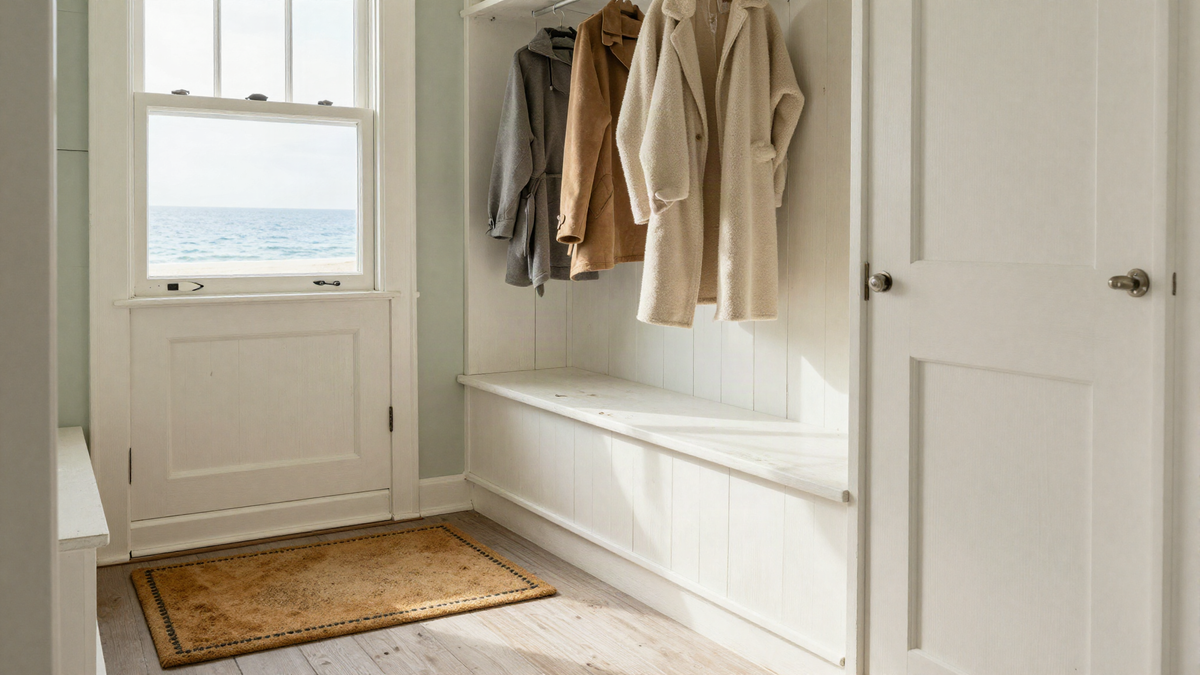
The other thing that works is boring: a real doormat outside and a second one inside, and a bench where people can get shoes off. Most of the sand in a coastal house is a mudroom design problem before it is a cleaning problem.
Marsh mud
North of Cape Ann this is the actual local problem rather than sand. The marsh systems around Essex, Ipswich, Rowley, and Newbury produce a fine dark silt that is nothing like beach sand. It dries to a film rather than a grit, it stains grout and unsealed stone, and it has a smell when it is wet.
What to do. Let it dry completely before you touch it. Wet marsh mud smears and sets. Dry, it lifts with a vacuum and then wipes. Everyone's instinct is to attack it wet, and that instinct is wrong.
Damp, which is the one that actually costs money
Coastal humidity keeps bathrooms and basements from drying between uses, and that is where you get mildew at the ceiling line and in grout. This is a ventilation problem wearing a cleaning problem's clothes.
What to do. Run the bathroom fan for twenty minutes after a shower, not two. Take the fan cover off twice a year and wash it, because a clogged cover means the fan is moving almost nothing. If a basement smells in August, a dehumidifier does more than any cleaning will.
Old coastal houses specifically
Federal era houses on the High Street side of Newburyport, the First Period houses in Ipswich, and the older stock in Gloucester all share the same features: deep box sashes, wide plank floors, painted floorboards, and a lot of trim. Every one of those holds grit in a corner. Deep sashes in particular collect sand and salt in the bottom channel and nobody ever looks in there.
A schedule for a coastal house
- Every visit. Window sills, door tracks, stair tread edges, entry floors.
- Monthly. Door and window hardware wiped, mudroom fully emptied and done underneath.
- Seasonally. Full window tracks and channels, bathroom fan covers, grout checked.
- Twice a year. A deep clean, ideally after the heating season and again before it starts.
We build coastal visits around this rather than working a generic checklist, which is most of what the town pages are about. If you want yours, they are all listed on the service area page, or you can get a price for your house from the price tool.
Where we clean
- House cleaning in Newburyport
- House cleaning in Amesbury
- House cleaning in Salisbury
- House cleaning in Newbury
- House cleaning in West Newbury
- House cleaning in Rowley
- House cleaning in Georgetown
- House cleaning in Ipswich
- House cleaning in Haverhill
- House cleaning in Seabrook
- House cleaning in Hampton
- House cleaning in Exeter
Keep reading

Move In Cleaning: What to Do Before the Furniture Arrives
There is a window between closing and the moving truck where the house is empty and every surface is reachable at onc...
Plant-Based Cleaning Products: What They Do and What They Do Not
Green cleaning marketing is close to meaningless, and some of it is not legal. Here is what the words actually mean, ...

Closing Up a Seasonal Home on the North Shore
A house that sits empty through a New England winter fails in predictable ways. Most of them are prevented in the two...
